- XRechnung and ZUGFeRD, checked against EN 16931
- Self-billing under § 14 (2) UStG
- Three portals: agency, freelancer, client
- Two-factor sign-in and passkeys
Where the time goes today
- Hours arrive by mail and Excel and are typed in again.
- The invoice to the client and the self-billed invoice to the freelancer are made by hand.
- For bookkeeping and the tax adviser everything is gathered once more.
How it works
From the timesheet to the invoice in three steps
Freelancers record their hours, agency and client approve, TitanBill creates the service record, the invoice and the self-billed invoice.
Record the hours
Freelancers book their time in their own portal – per day and project – and submit the month.
Approve
The agency checks the month, the client approves it in their portal or rejects it – with a reason if they like.
Bill
An approved month turns into a service record, the invoice to the client and the self-billed invoice to the freelancer – as an e-invoice too.
What it looks like
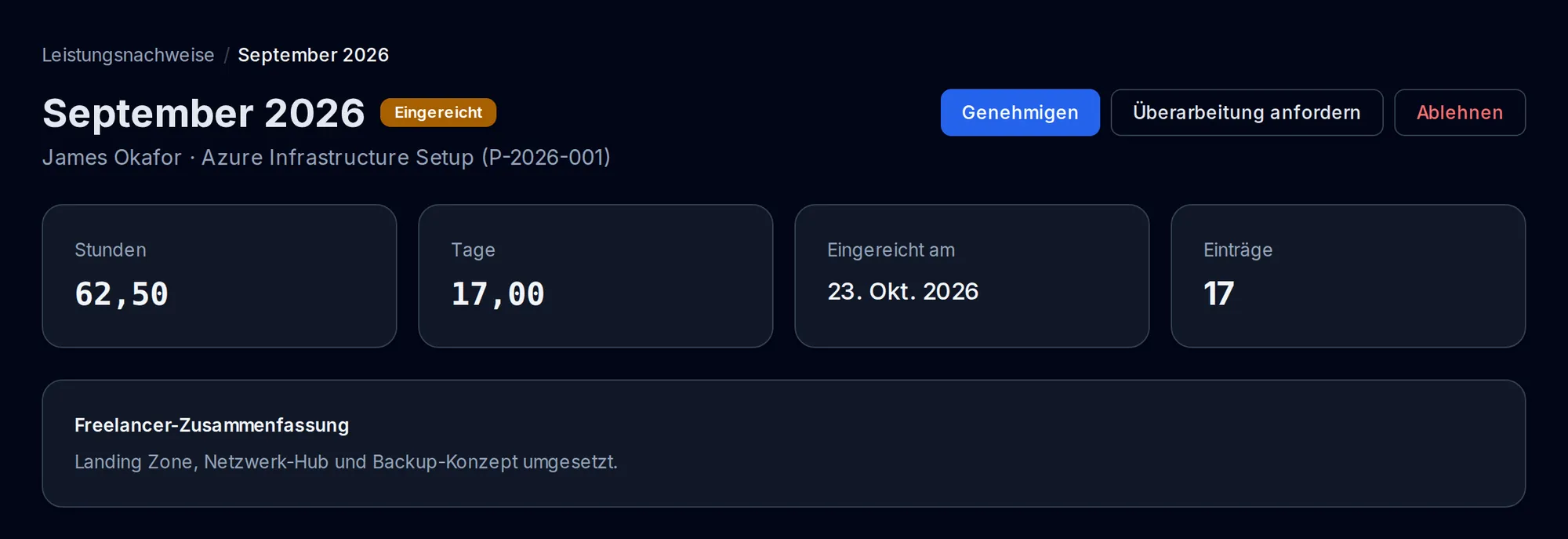
A month, from the timesheet to the archive
Screens from TitanBill with sample data of an invented agency.
For bookkeeping and the tax adviser
What bookkeeping needs comes along by itself
Documents, payments and exports in one place – as they were issued.
E-invoice
Invoices as XRechnung or ZUGFeRD, checked against EN 16931 before they are sent.
An archive that cannot be changed
Issued invoices and self-billed invoices are stored unalterably and kept for the legal period (§ 147 AO).
Dunning
Reminder levels with default interest and the 40-euro flat fee under § 288 BGB – automatic if you wish.
Bank statement import
Read bank statements in CAMT format and match payments to the open invoices.
SEPA payout
Self-billed invoices as a SEPA file (pain.001) for your online banking – the money goes straight from your account to the freelancers.
Four eyes
Above €1,000 a second person approves before a payment is entered by hand, an invoice is cancelled or written off, or a payout file is released. Where there is nobody else in the agency, the step waits 24 hours.
Early payment for a discount
Freelancers ask for earlier payment of a self-billed invoice and grant a discount for it; you pay from your own account.
Foreign currencies
Invoices in foreign currencies too. Reports show each currency separately; conversions use fixed reference rates for 16 currencies.
Export for a tax audit
Data in the GDPdU format for the tax authority, plus CSV exports for bookkeeping.
For the team
The agency's day in one place
Projects, orders and freelancers – with the overview of who is free when.
Workload and scheduling
Who is booked when, who is free – across all projects.
Orders with a volume
Each order has a money volume; TitanBill tells you at 80 and at 100 per cent.
Contracts
Contracts for each placement – with the freelancer and with the client – with reminders 30, 7 and 1 day before the end.
Excel import
Read existing billing sheets with hours, buy and sell rates, and check the margin.
Recurring invoices
Monthly, quarterly or yearly, TitanBill creates them by itself; they are sent when you switch it on.
Rules
When something happens: notify the team, send a payment reminder, open a ticket, call Slack or a webhook.
Chat and tickets
Talk to freelancers and clients without mails getting lost.
Three portals
Each side sees what it needs
Agency, freelancer and client each work in a portal of their own – with rights of their own.
Agency
- Freelancers, clients, projects and orders
- Check and bill the months
- Payments, dunning and payouts
- A team with roles from viewer to administrator
Freelancer
- Record time and submit the month
- See self-billed invoices and own invoices
- Ask for early payment for a discount
- Profile, documents and tickets
Client
- Approve months and service records
- See invoices and – where the agency offers it – pay online
- Projects and documents
- Tickets and chat with the agency
AI assistant
An assistant that asks before it acts
The AI assistant answers questions about your data in plain language and prepares actions. Nothing runs until you confirm.
Each agency can store its own AI key; you choose the model and the features.
Security and data protection
Protection for money, accounts and data
What one person should not do alone asks for a second one, or for notice.
Sign-in
Two-factor sign-in and passkeys; for administrators and finance the second factor is required.
Device list
See where you are signed in – and sign out one device or all others.
Roles
Four roles – administrator, project manager, finance and viewer; each sees and may do what it needs.
Administrators with notice
Removing, switching off or demoting an administrator is announced 72 hours ahead; the person concerned and every administrator can stop it.
Protected payouts
When a payout account changes, the freelancer gets an email with a link that holds their payouts – until an administrator releases them with their password.
Audit log
What your agency's people, your freelancers and clients do – sign-ins, roles, payments, cancellations – is in the agency's log with person and time.
Access and erasure
Tools for access, export and erasure under the GDPR; an erasure waits 24 hours and can be stopped.
Questions
What agencies want to know first
What does TitanBill cost?
Prices on request. They depend mainly on the number of your users and freelancers and on the features you need.
Is TitanBill payroll or software for temporary staffing?
No. TitanBill bills self-employed freelancers you place with clients – no wages and no temporary staffing.
Does TitanBill do e-invoices?
Yes. Invoices come as XRechnung or ZUGFeRD if you wish and are checked against EN 16931 before they are sent. TitanBill can read incoming e-invoices too.
How do self-billed invoices work?
With self-billing you issue the invoice for the freelancer (§ 14 (2) UStG). They see it in their portal and can object; whoever prefers to write their own invoices uploads them.
What does my tax adviser get?
The issued documents themselves, CSV exports and the export for a tax audit in the GDPdU format.
Who sees what?
Freelancers see only their own time and billing, clients only their projects and invoices. Inside the agency the role decides what someone may see and change.
How do I start?
You request a demo. Then we set up your access; you invite your freelancers and clients yourself.
See it with your own processes
We will gladly show you TitanBill live – with a month as it runs at your agency.